Artificial Intelligence is evolving faster than ever. Every few months, a new term starts trending — first it was “Generative AI,” then “AI Agents,” and now people are talking about “Agentic AI” as the future of autonomous systems.
But here’s the real question:
Are these just different names for the same thing, or do they represent different levels of intelligence?
If you’ve been confused about how Generative AI differs from AI Agents — and what Agentic AI actually means — you’re not alone. In this guide, we’ll break it down in simple, practical terms so you can clearly understand what each one does and why it matters. Let’s start from the basics.
What is Generative AI?
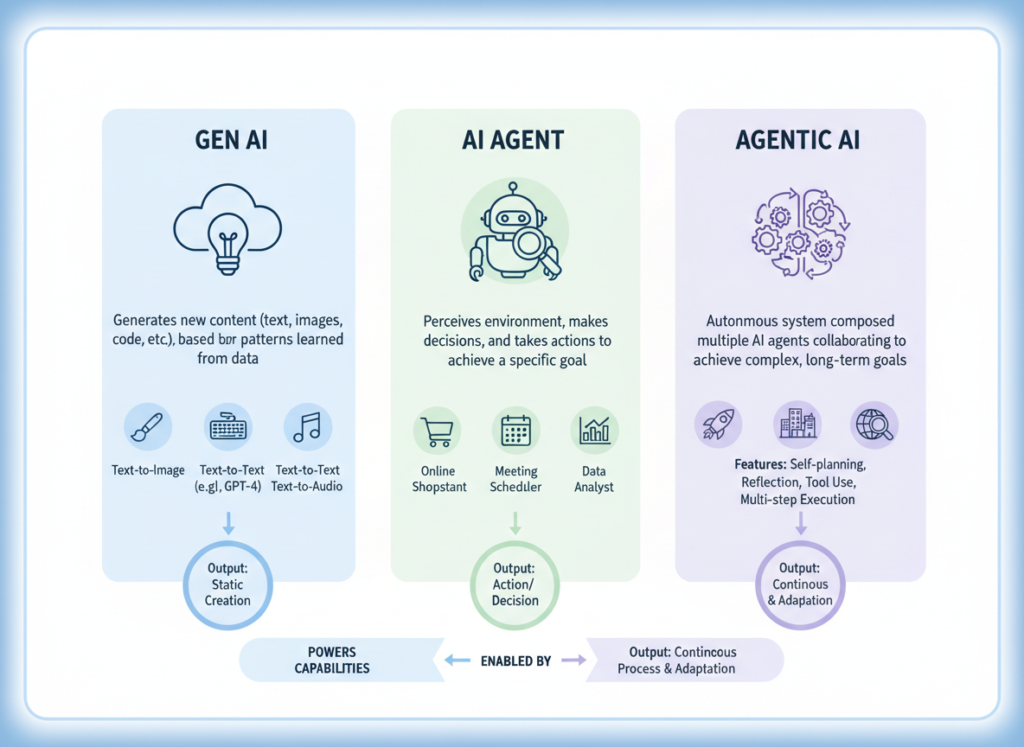
Generative AI refers to AI systems that create new content. This content can be text, images, videos, code, music, or even voice.
When you give a prompt to a system developed by OpenAI, such as asking it to write an email or generate an image, it analyzes patterns from massive datasets and produces a response based on probability and learned structure.
Key characteristics of Generative AI:
- It responds to prompts.
- It generates output based on patterns.
- It does not act independently.
- It does not make long-term decisions.
In simple words:
Generative AI creates — but it does not decide.
Common Use Cases
- Blog writing
- Image generation
- Code suggestions
- Marketing copy
- Social media captions
It’s powerful, but it works only when instructed.What is an AI Agent?
Now let’s move one step forward.
An AI Agent is not just a content generator. It is a system designed to achieve a goal.
Instead of just responding to prompts, an AI agent can:
- Take actions
- Use external tools
- Access APIs
- Execute tasks step by step
For example, imagine you tell an AI system:
“Research the top AI tools, compare pricing, and send me a summary by email.”
A generative model alone can write a summary.
But an AI agent can:
- Search the web
- Collect data
- Analyze pricing
- Compile the summary
- Send the email
This is goal-driven behavior.
In simple terms:
Generative AI writes.
AI Agents act.
That’s the key difference.
What is Agentic AI?
Now comes the most advanced concept: Agentic AI.
Agentic AI refers to systems that go beyond basic task execution. These systems can:
- Plan multiple steps in advance
- Break big goals into smaller tasks
- Decide which tools to use
- Adapt when something fails
- Self-correct during execution
Organizations like Google DeepMind are researching more autonomous systems that move closer to this vision.
Agentic AI doesn’t just follow instructions — it behaves with a level of autonomy.
Here’s the simplest way to understand it:
- Generative AI = Creates content
- AI Agent = Completes assigned tasks
- Agentic AI = Plans, decides, and executes independently
Agentic AI is still evolving, but it represents the direction in which AI development is heading.
A Simple Real-Life Analogy
Let’s make this crystal clear with an analogy.
Imagine a company environment:
- Generative AI is like a content writer. It writes when you tell it what to write.
- An AI Agent is like a personal assistant. You assign a task, and it completes it.
- Agentic AI is like a manager. It understands objectives, creates strategies, assigns tasks, and monitors results.
Same ecosystem. Different levels of autonomy.
Side-by-Side Comparison
Here’s a simplified comparison:
Generative AI
- Focus: Content creation
- Autonomy: Low
- Decision making: No
- Tool usage: No
AI Agent
- Focus: Task completion
- Autonomy: Medium
- Decision making: Limited
- Tool usage: Yes
Agentic AI
- Focus: Goal achievement
- Autonomy: High
- Decision making: Advanced
- Tool usage: Yes
- Planning ability: Multi-step
Why Agentic AI Is Considered the Future
The reason Agentic AI is gaining attention is simple: automation.
Businesses don’t just want content generation anymore. They want systems that can:
- Run workflows automatically
- Handle customer queries
- Manage research tasks
- Execute multi-step processes
Agentic systems reduce human intervention and increase productivity. However, it’s important to note that fully autonomous AI is still under development. Today’s systems are powerful — but not completely independent.